
Best Trucks for Owner-Operators
What actually matters when the truck is your business rather than your employer's: resale, fuel, the workshop network, and the number most people work out too late.
For an owner-operator the truck is not equipment, it is the whole business. That changes the criteria completely — a fleet buyer optimises for cost per kilometre across fifty units and can absorb a bad one, and you cannot.
1. Resale value, decided on the day you buy
Resale is the largest number in owner-operator economics after fuel, and it is fixed at purchase, not at sale. Kenworth is the clearest example in the Australian market: locally assembled to order, specified for local conditions, supported by a genuine rebuild culture, and consequently holding value better than anything else on the road here. It led the heavy-duty segment in 2025 with 3,347 units and 23.4% of the segment.
A ten-year-old Kenworth asking a price that looks irrational next to a European truck of the same age is not irrational. It reflects a real market of buyers who want it.
2. Where the workshop is
Downtime is direct lost income with no salary behind it. Before the badge, answer: where is the nearest dealer who knows this truck, where is the nearest independent who does, and can you get a part in a day on the route you actually run? A theoretically better truck serviced four hours away loses to an adequate truck serviced locally, every time.
3. Fuel, and the honest version of the numbers
Fuel is usually the largest operating cost. A 5% difference in consumption is real money over a year — but so is a $30,000 difference in purchase price, and the two need comparing on the same page rather than separately. Work out the fuel saving over your actual annual kilometres before paying a premium for it.
4. The driver, who is you
You will spend more waking hours in this truck than anywhere else. Cab comfort, seat quality, noise, air conditioning and bunk quality are not luxuries in that context — they are fatigue management, and fatigue is a safety and compliance issue as much as a comfort one.
5. Specification for the work, not for the ad
- GCM rated for your actual combination, with a little headroom, and no more. Excess rating is tare weight you carry forever.
- Driveline matched to your terrain. A highway-geared truck struggles on hills and a low-geared truck wastes fuel on the flat.
- Automated manual versus manual — automated is easier, better for resale to a wider pool of buyers, and more expensive to repair.
- Sleeper only if you actually sleep in it. It costs money, tare weight and fuel every day if you do not.
The number most people work out too late
Not the purchase price. The monthly total: repayment, insurance, registration, tyres set aside, service set aside, and a genuine allowance for the repair you have not had yet. Then compare that against realistic revenue for your work, with realistic downtime built in.
- A cheaper truck with higher maintenance can cost more per month than a dearer, newer one.
- Tyres and services are predictable expenses. Put them aside monthly rather than meeting them from whatever the month produced.
- Insurance on an owner-operated prime mover is substantial and varies enormously by driver history and use. Quote it before you commit, not after.
- Finance structure matters as much as rate — the term, the balloon, and whether the repayment survives a bad month.
The current prime mover market
Read from our index on 10 August 2026 · 338 matching listings · median asking price $149,950 · $550 to $632,500
What is available now
Recently listed prime movers
Read from our index on 10 August 2026 · 338 matching listings · median asking price $149,950 · $550 to $632,500
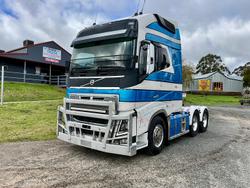
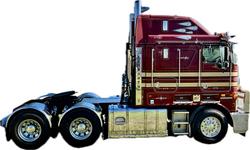
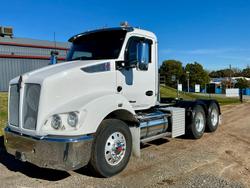
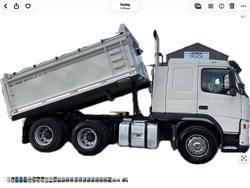
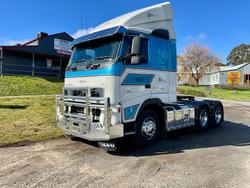
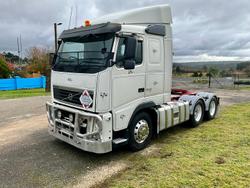
Prime movers under $150,000
Read from our index on 10 August 2026 · 139 matching listings · median asking price $119,900 · $550 to $150,000
| Machine | Year | Usage | State | Asking |
| 2007 Kenworth T404SAR GLB Equipment Sales | 2007 | — | QLD | $150,000 ex GST |
| 2022 Freightliner Cascadia 126 Larsen's Truck Sales | 2022 | 395,000 hrs | VIC | $150,000 GST n/s |
| 2018 Volvo FM500 Prime Mover STM Trucks & Machinery | 2018 | 6,338 hrs | NSW | $149,900 GST n/s |
| 2019 Mercedes-benz Actros 2646 T613047 SelecTrucks | 2019 | 600,000 hrs | VIC | $149,000 GST n/s |
| 2019 Mercedes-benz Actros 2658 T612275 SelecTrucks | 2019 | 750,000 hrs | VIC | $145,000 GST n/s |
| 2021 Freightliner Cascadia 116 T613492 SelecTrucks | 2021 | 76,000 hrs | VIC | $145,000 GST n/s |
| 2016 Volvo Fh 600 Globetrotter 600Hp Rebuild Hist $131800+Gst Truck Wholesalers Australia | 2016 | 1,314,183 hrs | VIC | $145,000 GST n/s |
| 2021 Freightliner Cascadia 126 T613145 SelecTrucks | 2021 | 795,000 hrs | VIC | $144,990 GST n/s |
| 2021 MAN TGX 26.540 6X4 Renall Truck & Machinery | 2021 | 607,645 hrs | WA | $140,000 inc GST |
| 2014 Kenworth T659 DAY CAB 97T RATED Larsen's Truck Sales | 2014 | 1 hrs | VIC | $140,000 GST n/s |
| 2018 Kenworth K200 Larsen's Truck Sales | 2018 | 1,400,000 hrs | VIC | $140,000 GST n/s |
| 2014 Kenworth K200 Bigcab Isxe5 Recent Hist Seecond $127300+Gst Truck Wholesalers Australia | 2014 | 723,092 hrs | VIC | $140,000 GST n/s |
Sources
- Truck Industry Council new heavy vehicle sales, full year 2025, as reported by Big Rigs, 8 January 2026: Kenworth 3,347 heavy-duty units, 23.4% of the heavy-duty segment.
Common questions
What is the best truck for an owner-operator in Australia?
There is no single answer, because it depends on your route, terrain, combination and where your nearest workshop is. The criteria that matter most are resale value, parts and service availability where you operate, fuel consumption over your actual annual kilometres, and correct specification for the work. Kenworth's strong resale makes it a common choice for heavy work.
Should an owner-operator buy new or used?
Used, usually, but not cheap. The steepest depreciation happens early, so a well-documented three to six year old truck avoids the worst of it while retaining service life. The exception is where new-truck warranty and finance terms produce a lower total monthly cost than an older truck plus its maintenance risk.
How much should I budget beyond the repayment?
Insurance, registration, a monthly set-aside for tyres and services, and a genuine allowance for unplanned repairs. Operators who only budget the repayment are the ones caught out by a tyre set and a service landing in the same month as a quiet fortnight.
Looking for something specific?
Search live stock from Australian dealers, or work out what a repayment looks like before you start.